Sun Ultra 2
Gallery
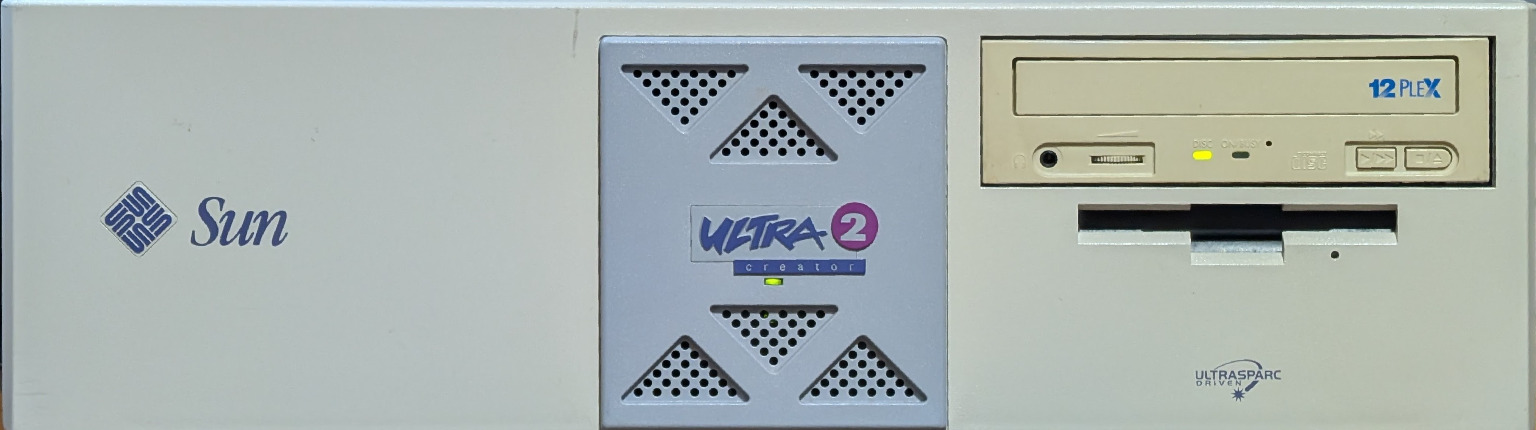
Image of OSfOM.org Collection's Sun Ultra 2.
Technical Specifications
| Model: | Sun Ultra 2 |
|---|---|
| Codename: Platform: |
Pulsar (A14) sun4u |
| Processor: Math Copro: |
2x UltraSPARC I or II (in CPU) |
| Clock Speed: | 143, 167, 200, 300, 400MHz |
| RAM: | 128 MB (Max. 2 GB) |
| Graphics: | |
| Operating System: | SunOS 2.5.1 bis Solaris 9 |
| Introduced: | November 1995 |
| Dealer price (net): |
The Sun Ultra 2: Dual-Processor Powerhouse
Sun Microsystems introduced the Ultra 2 workstation (code-named "Pulsar") in 1996 as the follow-up to the Ultra 1. The model brought multiprocessing support to the UltraSPARC desktop line.
The system accommodated up to two processors. Initial configurations used UltraSPARC I chips running at speeds up to 200 MHz, while later revisions supported UltraSPARC II processors at up to 400 MHz, or 450 MHz with later CPU modules. Combined with a 64-bit architecture and the UPA interconnect, the dual-processor design handled multithreaded workloads common in scientific, engineering, and software development settings.
The Ultra 2 used an updated version of the desktop "pizza box" chassis found on earlier SPARCstations. Expansion options included multiple SBus slots and a UPA slot for graphics cards such as the Creator3D and Elite3D series, which were used for visualization and other graphics-intensive tasks.
Sun positioned the machine as a high-end workstation for server roles and computationally intensive workloads. Running Solaris, it was deployed throughout enterprise and research environments during the late 1990s.